

Through fields and forests, rice plantations and far away mountains we passed, as we sat almost 10 hours in a rocky riding train from Bangkok to Chiang Mai, digesting our first days in Bangkok.
Our first common impression of Chiang Mai: cleaner, in a way “fancier”, more orientated to tourism. But also slower, calmer, easy-going – contrasting the packed and fast moving pace of the capital. My stomach celebrated the first GMO-free meal in days, being it one of the best curry’s I have tried here so far.
The Organic Landscape of Jing Jai Market
Bright, shiny and a little sleepy, we met with my good friend Fern at her favourite local organic market: Jing Jai – a market that has become known among tourists for its arts and crafts. However, if you go further to the back, you can find not only good coffee – which we desperately needed that day – but also a very large space where local farmers sell their organic fruits, vegetables – and of course food. Over a delicious breakfast, we talked to dear Fern, who, apart from being a very knowledgable food passionate herself, could enrich our minds with a local perspective on food, local traditions and habits, food trends in Thailand.

Omushabeh! – two days with members of the Karen Hill Tribe
It is hard trying to grasp the experience we had on those two days of intense immersion into rural hill tribe surroundings.
To give you a bit of context: in Thailand, there are quite a few hill tribes who still live in communities that are apart from the rest of the Thai community. Hill tribe in this sense meaning: ethnic minority groups who migrated from Laos, China, Myanmar and came to settle in northern Thailand, several hundred years ago. As the fight for the border between Thailand and Burma/Myanmar continues, migration of community members is still ongoing. Differences between the tribes mainly lie in beliefs, rituals, clothing, the way of house construction for instance, or – in food and food preparation. Some of the largest communities around Chiang Mai and the northern part of the country are the Akha, Hmong, and Karen – the last of which we visited.
Chai, our Karen guide, led us through different ethnic communities along the way, as well as through rice and pumpkin fields, rivers and streets of his Karen village, called Muang Ngam, on the border to Burma. We learned that most of the crops and animals grown are supplied to a large distributor. In a conversation with a local, I discovered that his aspiration is to grow pigs in a traditional way, without antibiotics. Another guide and one of the trip’s organisers, Pat, has the goal to empower local people by teaching English, and is trying to find volunteers to help. After these conversations by the open fire, a delicious meal cooked by our lovely host Masu and watching a blinking clear night sky, we spent the night in a hut made entirely out of bamboo, the typical housing of the Karen people.


Between Activism & Spice – a day at Studio HorJhama
What an inspiring day!
When we had finally managed to grab a Grab to Ann-Sasithorn Kamrit‘s studio, we had no notion of the insights, laughter, and deliciousness that were awaiting us.
Ann is the owner of Studio HorJhama, a little clay-built house with a lovely green yard, alive with dancing leaf shadows and flowers. There, you can buy local organic products, learn about local Akha culinary knowledge, and listen to the air that is often filled with laughter and delicious smells originating from Ann’s Akha cooking workshops. Which is precisely what we did!
Ann and Yoko (an artist currently exhibiting at Studio HorJhama) kindly received us in the refreshing backyard, where Ann shared her perspective on development of the food system in Thailand, as well as insights of her work as a food activist and educator. Her goal is to empower people, e.g. local farmers and schools, with knowledge on preparing food with local ingredients, so that they can grow healthy organic plants and self-sustain themselves in an urban environment.
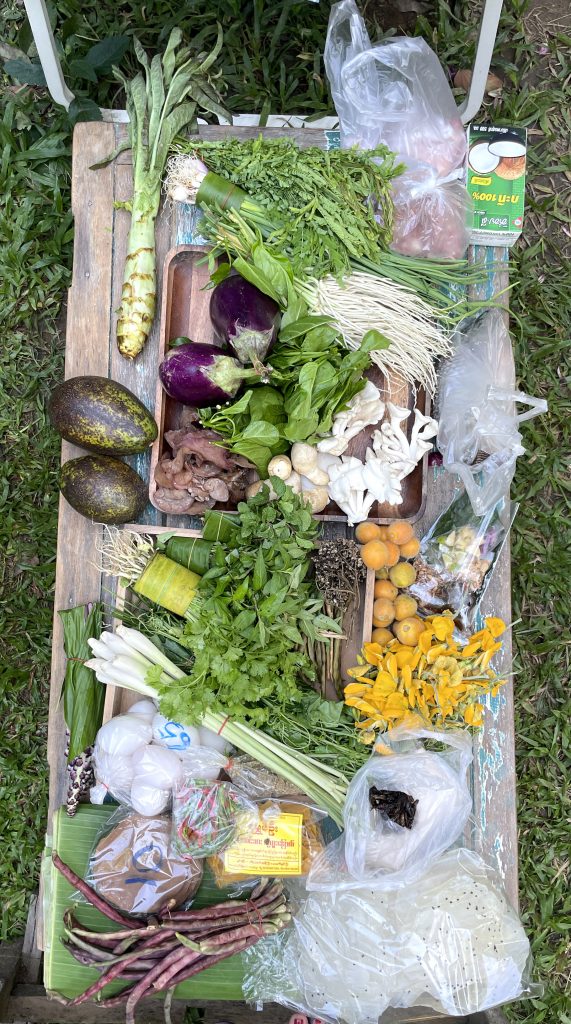
Our conversation went further over a delicious lunch Ann’s mother had prepared for us. And it went further as we drove to the local farmer’s market to buy ingredients for our Akha inspired dinner we would cook together. Showing us how to identify vegetables grown organically from the ones grown with the help of chemicals, we went back with a basket full of what seemed random ingredients including pork, fish, a bunch of unknown leafs, and alive coconut worms!
Our “four-course” dinner slightly escalated into a table of 17 different dishes, all of them with their own unique flavour and texture (see list below). It was an evening full of laughter and heartwarming conversations, and we left with more than a satisfied belly. And yes – we ate the worms, cooked and made into a paste with spices and onions. Yummy!


Last Day – Trust & Plants
Before returning to Bangkok by night bus, we met two other persons in Chiang Mai: Chef Marvin von Beesten from The Food Trust and Smith Taweelerdniti, founder of Let’s Plant Meat. Though two quite distiguishing perspectives on the future of food, both were equally interesting.
With Marvin we dived into an approach towards increasing local economy, self-sufficiency, towards a balanced diet and supporting farm-to-table systems. Smith took us into his vision of a meatless future without having to renounce to meat taste, the health risks behind a meat-based diet, sharing with us his perspective on the market for meat alternatives.
Filled with these two different inputs, we departed to a night full of snores, back to Bangkok.


Leave a Reply