

The capital city has been a welcoming tourist destination for several decades and retains its popularity for reasons beyond the food alone. Interestingly, this same diversity of the city sprawl plays a huge role in shaping the uniqueness of this city itself; the living culture, and the values with which the city planning has evolved.
Bangkok handles the pressures of incoming tourist traffic nearly year-round and is also the international hub of Thai corporate and commercial activities. This influences its food culture which isn’t entirely similar to the other regions of Thailand. Being near the coast, you’d often find seafood almost as a staple on the menus. Although there are several street food vendors and local markets supporting the convenience culture and fast-paced lifestyle of this city, the term fast food doesn’t find the same meaning as it would in the western world.
Even among Asian countries, the Thai food culture stands out with its relatively unique insect-eating culture….or so we thought. Word is, that not more than 10% of the locals eat insects. This could be attributed to the expensiveness of the insects as they’re collected/grown in other regions of the country and come to Bangkok not only bearing the additional costs of the logistics but also being sold for a premium. But apart from this the locals also share some stigma or mental blocks associated with the disgust factor of eating insects just like anyone from any other part of the world might. We tried them out for ourselves later in this trip
To challenge some of our assumptions and also dig deeper from a producer’s perspective, we paid a visit to Star bugs. The scientist/innovator and founder had an interesting journey of how innovating for paper pulp solutions eventually led him to find insect feed solutions and then to the cricket protein business we now know of. We expected the challenges of an insect protein business to be consumer attitudes but learned it’s even more so about the economies of scale. Of course both these are in a dynamic relationship with each other and the market push can only be as strong as the development of the capacity for a big enough market pull. Visiting Thailand in the aftermath of Covid, it’s evident that the progress in building trust towards food innovations and even insect protein has been hampered.

Another assumption with which we traveled here was that there would be more vegetarian options on the menus but were surprised to find most dishes had fish, prawns, or eggs if not a meat-based dish already. This could be to add components of Umami to the dish. It was even more interesting to note the relatively small portion sizes of the dishes. The servings of rice or noodles are equal to the protein and fats added to the dish but altogether the dish itself is not heavy probably to make space for finger foods and drinks. However, this is a healthy practice in general, and consuming a balanced diet of calorie-dense foods with small portions is known to have associations with longevity.
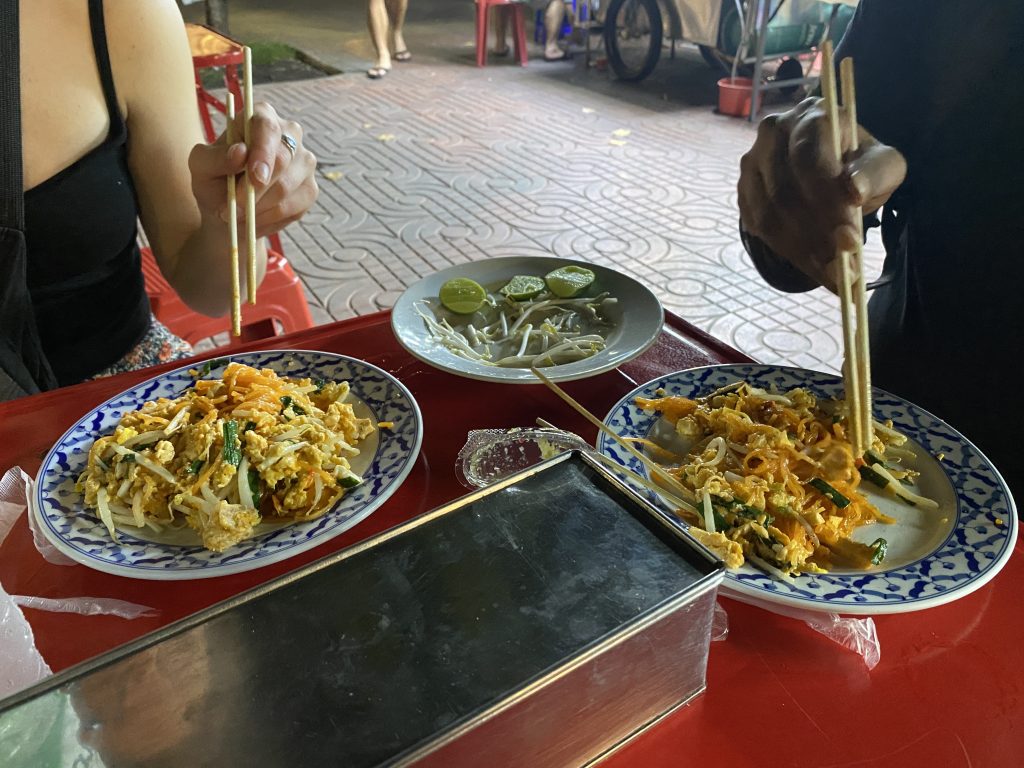
The street food was an overwhelming yet therapeutic experience of its own accord. Overwhelming because the diverse range of colors, aromas, packaging, and different shapes/forms of meats as well as unique snacks can be a lot for the uninitiated to mentally process. But still therapeutic as we were surrounded by so many options we felt we just couldn’t go wrong with. There was a lot of visual noise being concentrated in and around the food stands. It can be hard to name some of these dishes but it is equally hard to forget their flavors.

We visited the Thai union, the largest seafood manufacturer in the world, for a perspective on the alternative protein future in general but also within the Thai context. Seafood enjoys a very positive reception here, as their health/beauty benefits are well acknowledged, it’s interesting to see what the future of seafood alternatives will look like and how they will be marketed to the consumer segments as well.
Through our food tour experience, we were first familiarized with the tabooed history of alcohol brewing culture, and the influence of Chinese entities like Lao and Chang’s. We visited a few stalls that had packaged ready-to-go meals that were simple preparations but still diverse in the cultures they were able to capture among the varieties.

We jostled through a few crowded food streets to get to some stalls and small restaurants our guide Kim wanted us to experience.
1st stop: Oyster Mushrooms, Chicken Biryani
2nd stop: Duck eggs, Minced pork curry, Tilapia fish, Zucchini with egg, along with a Rice salad
3rd stop: Coconut pancake, Basil + sticky rice + papaya salad with green beans (spice), Kim’s favorite; Massaman curry, sticky mango rice + coconut milk.
4th stop: The best Ice cream store with unique flavors like blue cheese and red&white wine
5th stop: The most soothing green oolong tea experience (Tiguanyim tea) in Bangkok’s Chinatown district
We were often met with small menus; perhaps for the quick purchasing on-the-go lifestyle and to also ease the interaction process for foreign customers. Was interesting to note the popularity of Duck/Qual eggs over typical chicken eggs, as they are better in terms of nutrition. We came expecting more steamed foods but saw a lot more fried foods instead. Bowls of food are always served with a spoon for the soup, along with a fork or chopsticks to help grab the food.
Finally, the night market. We were welcomed by a flayed crocodile hanging right off a stall near the entrance and proceeded further to be swarmed by tourists. But not all of them were, as we found a few walking up to us with trays of insects; scorpions, spiders, and even found a vendor that carried a bigger variety this time with crickets, grasshoppers, bamboo worms, silkworm larvae.

It’s been an interesting few days for us and now to add more dimensions to our context-building of the Thai food culture, we leave behind the city to explore a notably different region in terms of culinary influence.

May Buddha continue to be generous to us as our journey continues.
Onwards and upwards…next stop; Chiang Mai.

Leave a Reply